
Launch week · 16 November 2026
GTA VI launch night: how the internet in your district is likely to hold up
Published 16 November 2026 · KASPR Datahaus

Your district
Check how the internet in your district is likely to hold up on GTA VI launch night
Names you type are looked up on our server; nothing else leaves your browser.
Search for a place above to read its district. The table ranks countries by the share of their districts that read “likely to hold”.
Countries ranked by the share of districts likely to hold
Countries with at least 20 measured districts, ranked by the share of their districts that read “likely to hold”.
| Country | Likely to hold | Slower evening | Strain likely |
|---|---|---|---|
| Germany | >99% | <1% | <1% |
| Spain | >99% | <1% | <1% |
| Poland | 99% | 1% | <1% |
| South Korea | 99% | 1% | <1% |
| Austria | 99% | 1% | <1% |
| Switzerland | 99% | 1% | <1% |
| Czechia | 98% | 2% | <1% |
| Netherlands | 98% | 2% | <1% |
| France | 97% | 3% | <1% |
| United Kingdom | 95% | 5% | <1% |
| Canada | 94% | 6% | <1% |
| Ireland | 92% | 8% | <1% |
| Moldova | 92% | 8% | <1% |
| Finland | 90% | 10% | <1% |
| Estonia | 90% | 10% | <1% |
| Bulgaria | 90% | 10% | <1% |
| North Macedonia | 88% | 12% | <1% |
| Denmark | 87% | 13% | <1% |
| Slovakia | 86% | 14% | <1% |
| Kenya | 85% | 15% | <1% |
| Portugal | 85% | 15% | <1% |
| Sweden | 83% | 16% | <1% |
| Romania | 80% | 20% | <1% |
| Latvia | 80% | 20% | <1% |
| Tunisia | 79% | 21% | <1% |
| Botswana | 77% | 23% | <1% |
| Greece | 76% | 24% | <1% |
| Chile | 76% | 24% | <1% |
| Norway | 75% | 25% | <1% |
| Hungary | 74% | 26% | <1% |
| United States | 71% | 28% | 1% |
| South Africa | 70% | 29% | <1% |
| Australia | 70% | 30% | 1% |
| Albania | 64% | 36% | <1% |
| Ukraine | 62% | 38% | <1% |
| New Zealand | 60% | 40% | <1% |
| Ecuador | 58% | 41% | 1% |
| Slovenia | 56% | 42% | 1% |
| Serbia | 56% | 42% | 1% |
| Russia | 55% | 44% | 2% |
| Japan | 53% | 44% | 3% |
| Lebanon | 50% | 46% | 4% |
| Costa Rica | 48% | 52% | <1% |
| China | 45% | 52% | 2% |
| Argentina | 45% | 51% | 4% |
| Morocco | 44% | 54% | 2% |
| Kazakhstan | 44% | 51% | 5% |
| Guadeloupe | 42% | 50% | 8% |
| Lithuania | 31% | 69% | <1% |
| Oman | 28% | 72% | <1% |
| Jordan | 26% | 61% | 13% |
| Iran | 24% | 74% | 2% |
| Puerto Rico | 24% | 73% | 3% |
| Egypt | 16% | 80% | 4% |
| Indonesia | 13% | 74% | 14% |
| Algeria | 12% | 79% | 10% |
| Italy | 9% | 91% | <1% |
| India | 6% | 69% | 25% |
| Senegal | 3% | 83% | 14% |
| Malaysia | 3% | 90% | 8% |
| Côte d’Ivoire | 2% | 92% | 6% |
| Bangladesh | <1% | >99% | <1% |
| Pakistan | <1% | 40% | 60% |
| Taiwan | <1% | 90% | 10% |
| Vietnam | <1% | 89% | 11% |
These readings are averages for a district or a country, drawn from its measured record. Individual experience is likely to differ: it depends on the local backbone and the provider’s network, on the type and plan of the household connection, and on the equipment and wiring inside the home.
The rule
Launch record: 4 or more rough days out of at least 10 measured launch days scores one point, 6 or more scores two. Thursday evenings: a share of rough evening hours of 55% or more scores one, 65% or more scores two. Disruption record: more than 4 disruption days a year scores one, more than 15 scores two. Nought or one point in total reads “likely to hold”, two or three “a slower evening is likely”, four or more “strain is likely”.
What a reading is, and is not
A reading describes the district’s record. It is not a measurement of Thursday, and it says nothing about any particular network or household connection. A district that reads “likely to hold” can still have a bad night, and one that reads “strain is likely” may pass unnoticed. The reading concerns the evening and night of release; during the day the network is usually quieter.
The operators’ account
Network operators prepared for the launch, and the first night still set records
In October, Openreach said the game had been on its planning horizon for some time and that it expected a new download record.[5] Comcast offered its customers a free fifteen-day increase in download speed for the launch period.[6] NBN Co in Australia stated that game releases produce some of the largest traffic peaks on its network and described the launch as potentially one of the largest download events it had seen.[7] Vodafone Germany reported throughput on the first morning about 60% above the previous day and said its network was dimensioned for such peaks.[8]
Not every network absorbed the demand without effect. One British fibre provider informed customers that demand for the game had caused a capacity problem and reduced speeds while traffic was redistributed.[9] This is the pattern to expect from an event of this size: national totals set records, while any degradation is local.
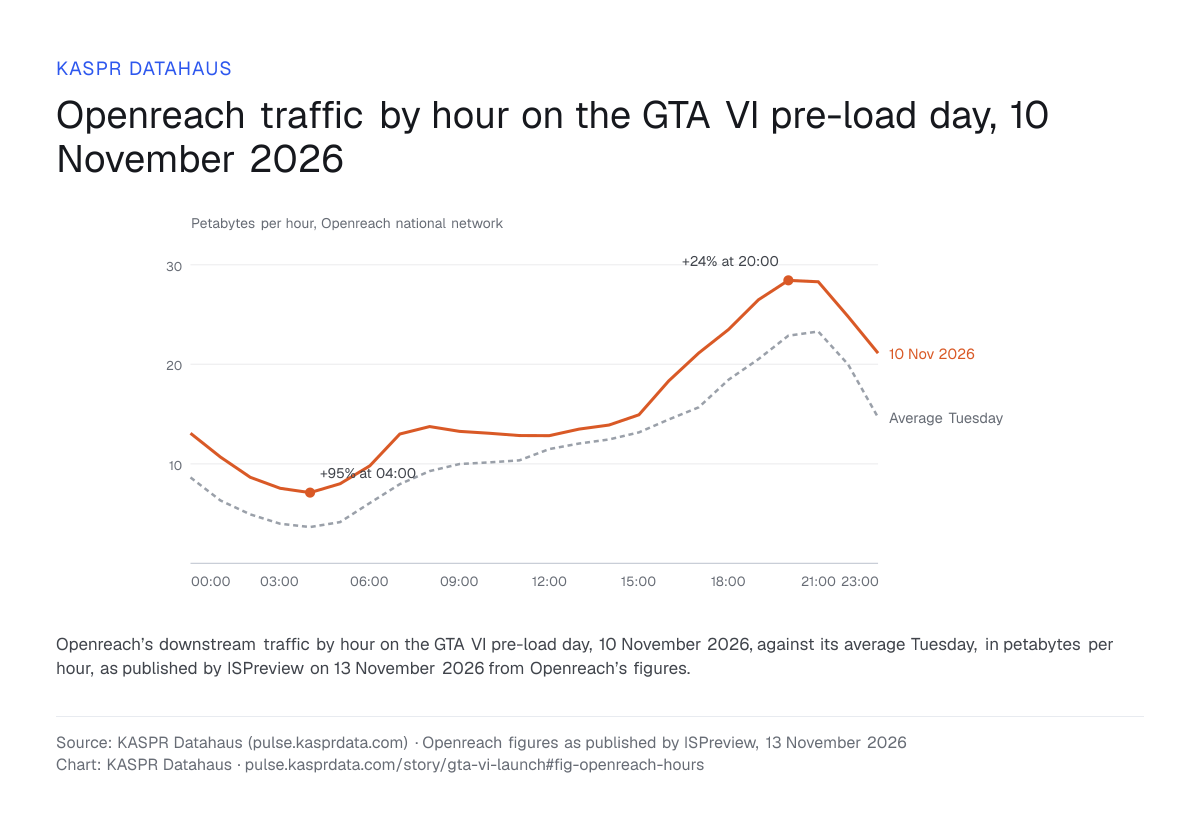
Openreach’s hourly figures describe the shape of a pre-load night. Traffic in the first hour after midnight was 52% above an average Tuesday; the increase peaked at 95% at 04:00; and the evening peak, when the network is already at its busiest, carried 24% more. Over the whole day the additional volume was 94 petabytes, equivalent at 212 GB per copy to about 440,000 complete downloads.
The record
What 24 launches did to measured internet conditions in 40 countries
The analysis covers 24 large game and console launches since 2019, from Fortnite Chapter 2 to Call of Duty: Black Ops 7, and 942 regions in 40 countries with large gaming markets. For each region and day, jitter and latency are compared with the median of the same weekday in the surrounding weeks. A region is counted as having a rough day when its value exceeds its own 90th percentile over the whole record, so that one ordinary day in ten qualifies by construction. Cyberpunk 2077, Helldivers 2 and Battlefield 6 coincided with days on which our measurement cannot be compared cleanly and are excluded, leaving 21 launch days to set against 2,417 ordinary days.
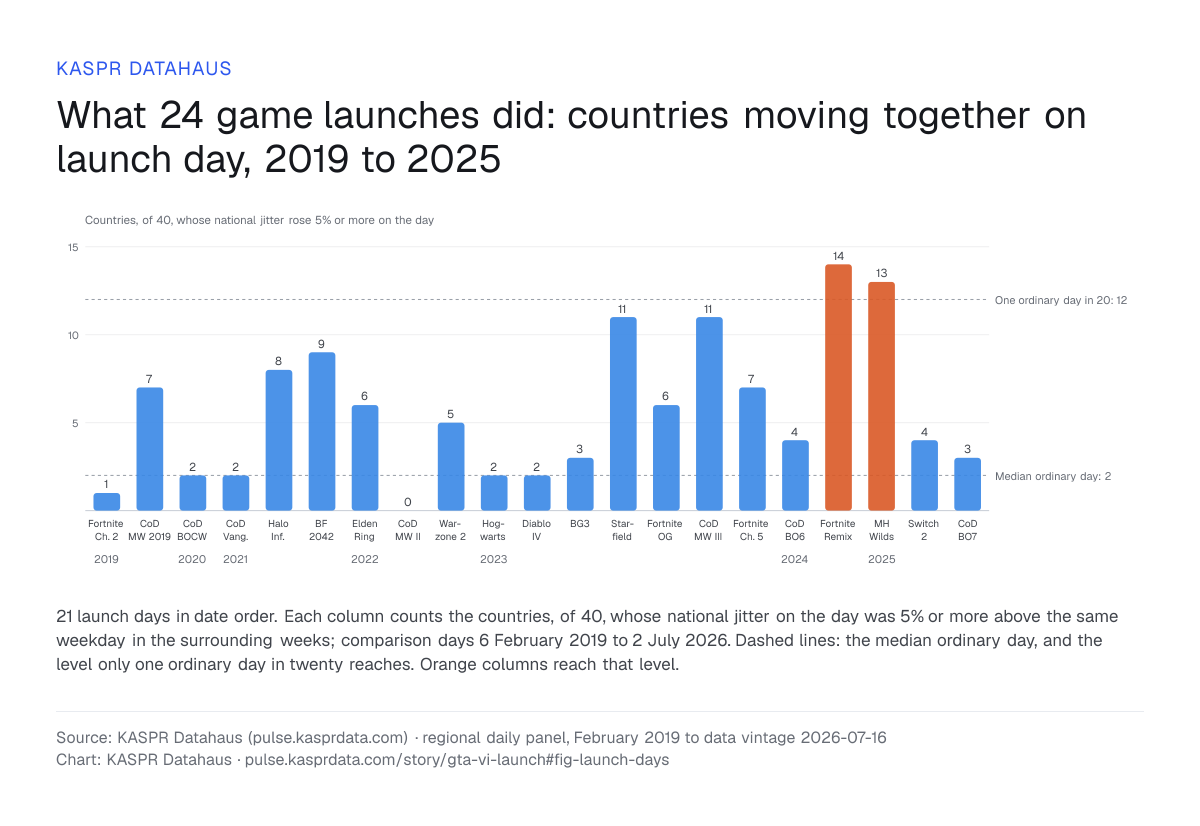
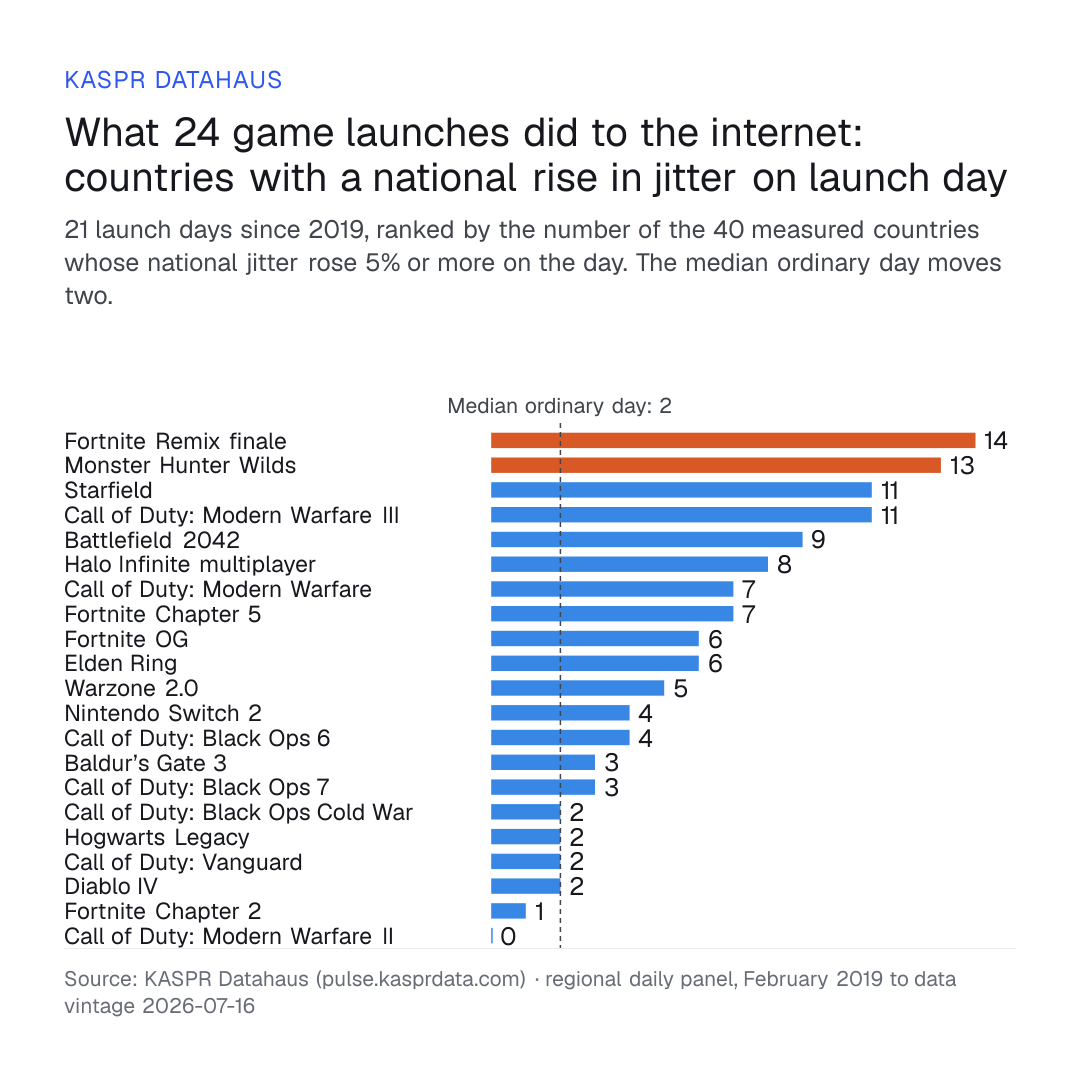
On the average launch day, 13.7% of regions had a rough jitter day, compared with 10.1% on an ordinary day, and 5.7 of the 40 countries showed a national rise in jitter of 5% or more, compared with 3.7. Latency behaved similarly, with 6.3 countries affected against 3.5. The median region changed little, +0.2% against −0.1%, while the region at the 90th percentile moved by 8.9% against 7.2%. The day after a launch, the share of regions with a rough day had fallen to 12.0%, and on the second day to 11.7%.
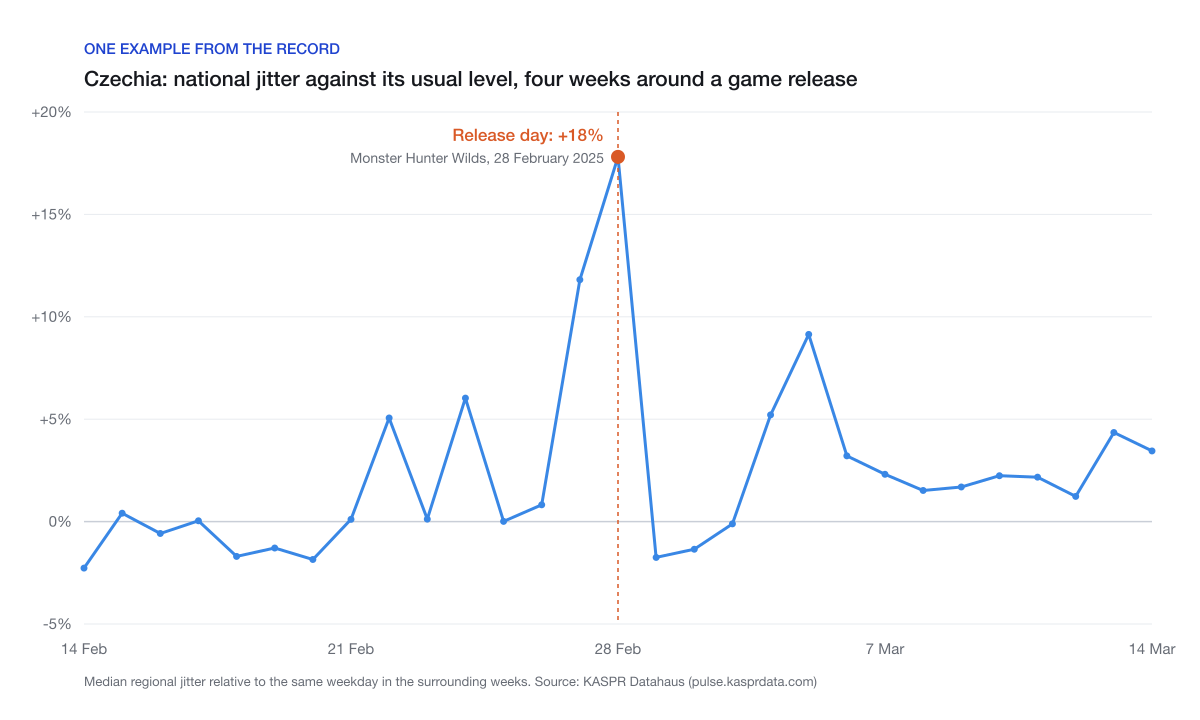
The average conceals a wide range. The Fortnite Remix finale on 30 November 2024 coincided with a national rise in 14 countries at once, and Monster Hunter Wilds with a rise in 13, of which 10 exceeded 10%: Sweden +21%, Italy +19%, Czech Republic +18% and Finland +17%. Only 6% of ordinary days reach 12 countries. At the other end, 6 launch days, among them Fortnite Chapter 2, Call of Duty: Black Ops Cold War and Call of Duty: Vanguard, moved no more countries than the median ordinary day, which is 2. 12 of the 21 launches took place on a Friday. GTA VI is released on a Thursday, with a working day on either side.
A lower bound, not a forecast
Why the coming week is likely to sit at the upper end of the range
Three considerations place GTA VI above the launches in the record. The pre-load day alone matched the largest game-related increase Openreach has reported, 33% against 30% on the day the Xbox Series consoles were released alongside a Call of Duty pre-load in 2020.[15] Congestion is a threshold phenomenon: additional load has no visible effect until a link is full, after which every connection sharing it degrades, so the response to a larger launch is more than proportional. And earlier launches spread their players across PC and console stores, whereas this one directs every buyer through two.
Two considerations point the other way. Pre-loading since 10 November has moved a large share of the downloads away from release day; in one poll, 46% of intending players planned to download before release.[2] Operators have also added capacity in anticipation. Openreach’s PlayStation 5 launch day in 2020 carried less traffic than an average weekday for that reason.[14]
A rough calculation for the United Kingdom, using published figures only, illustrates the scale. A Uswitch poll put the number of UK adults intending to play on release day at 2.8 million.[11] If 54% of them have yet to download the game, that is about 1.5 million copies, or roughly 320 petabytes across all UK networks, against the 284 petabytes Openreach carries on an ordinary day. Even if only a third of that volume falls on Thursday and the remainder over the weekend, it amounts to a further day on the scale of the pre-load day, before the day-one update and launch-week video streaming are counted.
In our own measure, the average launch raised the share of regions with a rough day from one in ten to 13.7%; the strongest, Monster Hunter Wilds, raised it to 28.4% and coincided with a national rise in 13 countries. A reasonable expectation for the coming week is therefore the upper end of that range: of the order of one region in four with a rough day rather than one in ten, concentrated between early evening and the early hours, with most places unchanged.
What the record does not show
The data record when and by how much conditions in a place changed, not why. A country-wide rise on a launch day coincides with the launch and is not attributed to it, and nothing here describes the performance of any individual network. The figures are daily, which dilutes an evening and overnight event by a considerable factor, and latency is measured from our vantage points, so it is an index of change rather than the delay a player experiences. The hour-by-hour profile of launch night is the subject of a follow-up once the week has been measured.
Practical implications
Households
The game is already available for download on both console stores. In most of the countries we measure, the quietest hours on the network fall between 03:00 and 06:00 and the busiest in the early evening, which is also when the first-night queue forms. A download scheduled overnight is complete by the morning.
Network operators and risk teams
The pre-load week serves as a rehearsal, and its figures are public. Thursday night can be compared with them, and regions compared with one another. In our record, the launches that mattered coincided with country-wide changes, and the degradation was concentrated in the regions already closest to capacity.
Further from KASPR
Regional intelligence for one place
The reading above draws on a fuller record for each district: its hour-by-hour profile, its disruption history and its standing within its country. A Location Intelligence report sets that record out for any place you name, for site selection, due diligence or local planning.
Plan the timing around launch week
KASPR Sense gives the quietest and busiest hours on the network for any town, from two years of hourly measurement. Teams scheduling calls, live streams or social media campaigns in launch week can check when their audience’s networks are usually least loaded, and risk teams can plan around the evenings most likely to be congested.
Model the next event
The data behind this story covers seven years of daily measurement, and two years of hourly measurement, across more than 30,000 districts. Researchers and analysts can use it to study how networks responded to past launches, sporting finals and outages, and to simulate how a region might respond to the next one.
Contact us
Sources
- Video Games Chronicle, “Rockstar details Grand Theft Auto 6 pre-load date and time, and file size”, 3 November 2026, quoting Rockstar Games.
- Virgin Media O2, “GTA VI breaks Virgin Media broadband records as fans rush to pre-load game”, 11 November 2026.
- ISPreview, “Openreach details UK broadband traffic impact from GTA 6 pre-loading”, 13 November 2026, with Openreach’s hour-by-hour figures.
- Push Square, “GTA 6 does not have online multiplayer at launch”, November 2026.
- ISPreview, “Broadband ISPs in the UK braced for monster 200–240 GB GTA VI download”, 28 October 2026, quoting Openreach’s Trevor Linney.
- Comcast, “Xfinity gives gamers a free 15-day WiFi speed boost for the highly anticipated Grand Theft Auto VI launch”, 9 November 2026 (Business Wire).
- GadgetGuy, “GTA 6: NBN Co expected to break Australian internet traffic records”, 10 November 2026.
- AWP via cash.ch, “Vorab-Downloads von GTA 6 treiben Datenverkehr in Deutschland in die Höhe”, 11 November 2026.
- Dexerto, “GTA 6 is causing internet issues as players rush to preload”, 11 November 2026, quoting YouFibre’s notice to customers.
- BambooHR, “GTA PTO: time-off requests for 19 November 2026”, 22 October 2026.
- Uswitch, “GTA VI warning for 13.5 million Brits: download could take more than two days in slowest broadband areas”, 9 November 2026, with an Opinium poll of 2,000 UK adults.
- HCA Mag, “Grand Theft Auto 6 could almost double worker absence”, 8 October 2026, on Deputy’s shift data.
- Virgin Media O2, “Call of Duty: Modern Warfare III drives another record day on the Virgin Media O2 network”, 10 November 2023.
- ISPreview, “Openreach reports high UK data traffic on PS5 launch day”, 20 November 2020.
- Virgin Media, “Virgin Media sees record-breaking network traffic on day of Xbox Series X|S launch”, 12 November 2020.
Further reading
- ISPreview, “Broadband ISP Squirrel Internet boosts UK network capacity for GTA VI”, 12 November 2026.
- IT Brief, “GTA VI pre-downloads drive record internet traffic”, 13 November 2026, on DE-CIX’s reported peak.
- Newswire NZ, “Grand Theft Auto VI pre-loads add 5.6 petabytes to New Zealand’s Chorus fibre network”, 16 November 2026.
- Kentik, “Anatomy of an OTT traffic surge: the Tyson–Paul fight on Netflix”, 21 November 2024.
- iTWire, “Akamai discusses traffic records post Fortnite’s 37 Tbps juggernaut”, 17 July 2018.
Charts: KASPR Datahaus regional daily panel, 6 February 2019 to data vintage 2026-07-16; Openreach figures as published by ISPreview, 13 November 2026. The logo in the lead image is credited beneath it.
Questions and answers
- Does KASPR’s data show the GTA 6 launch yet?
- Not yet. The record used here runs to data vintage 2026-07-16, and the pre-load figures quoted are the operators’ own, as published.
- Do big game launches slow down the internet?
- Across 21 launch days since 2019 in 40 countries, 13.7% of regions had a rough jitter day against 10.1% on an ordinary day, and 5.7 countries showed a national rise in jitter of 5% or more against 3.7. The median region moved +0.2%; the region at the 90th percentile moved 8.9% against 7.2%. The effect had largely faded by the following day.
- Which launches coincided with the largest changes?
- The Fortnite Remix finale on 30 November 2024 coincided with a national rise in 14 countries, and Monster Hunter Wilds with a rise in 13, of which 10 exceeded 10%. Only 6% of ordinary days reach 12 countries. 6 launch days moved no more countries than the median ordinary day.
- Is the GTA 6 launch larger than earlier game launches?
- On the published figures, yes. Openreach carried 33% more downstream traffic on the pre-load day than on an average Tuesday, against 30% on the 2020 Xbox and Call of Duty day, and the game is a 212 GB download through two console stores with no online mode to spread the demand. Pre-loading and added capacity work in the other direction, so the record is a lower bound rather than a forecast.
- When is the best time to download GTA 6?
- In most of the countries we measure, the quietest hours on the network fall between 03:00 and 06:00 and the busiest in the early evening, which is also when a launch-night queue forms. KASPR Sense gives the quietest hour for any town from two years of hourly measurement, and the Atlas on this site shows every country’s hourly profile.