
KASPR Datahaus · 15-minute record
The Bangladesh shutdown of 5 August 2024, seen from Dhaka at 15-minute resolution
Window: 4–6 August 2024 · Dhaka, Bangladesh · 15-minute export
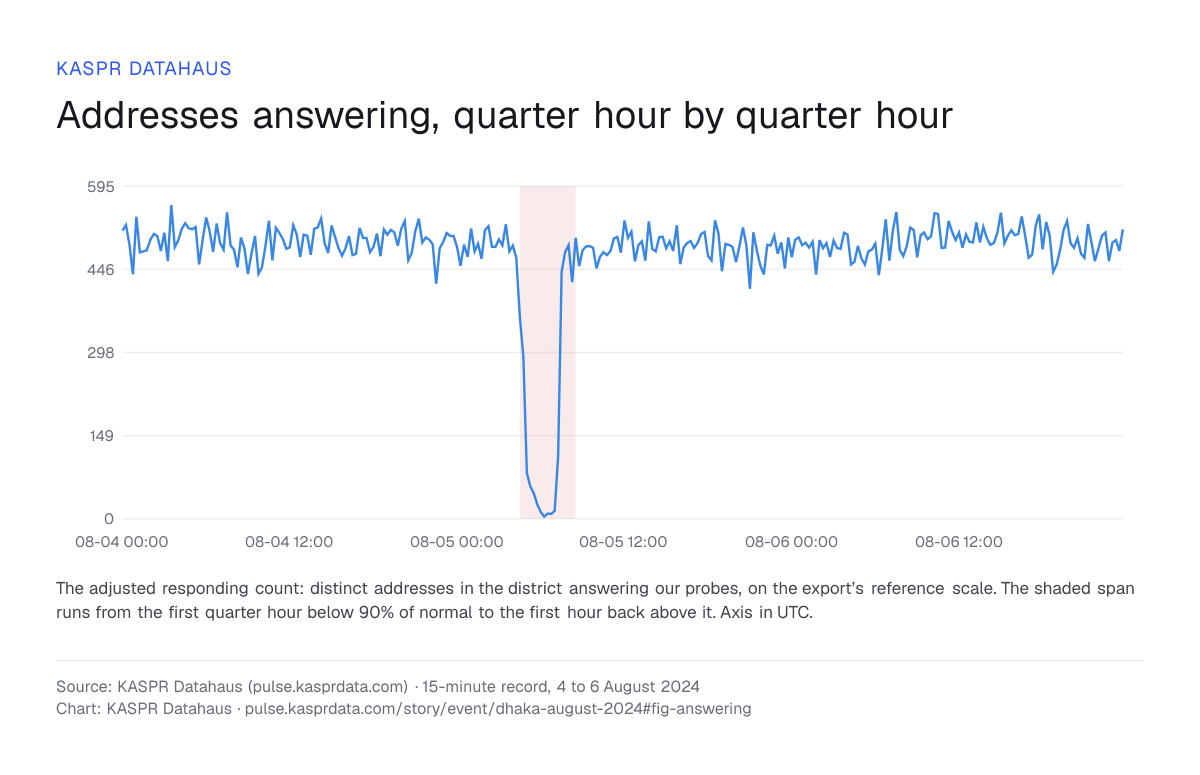
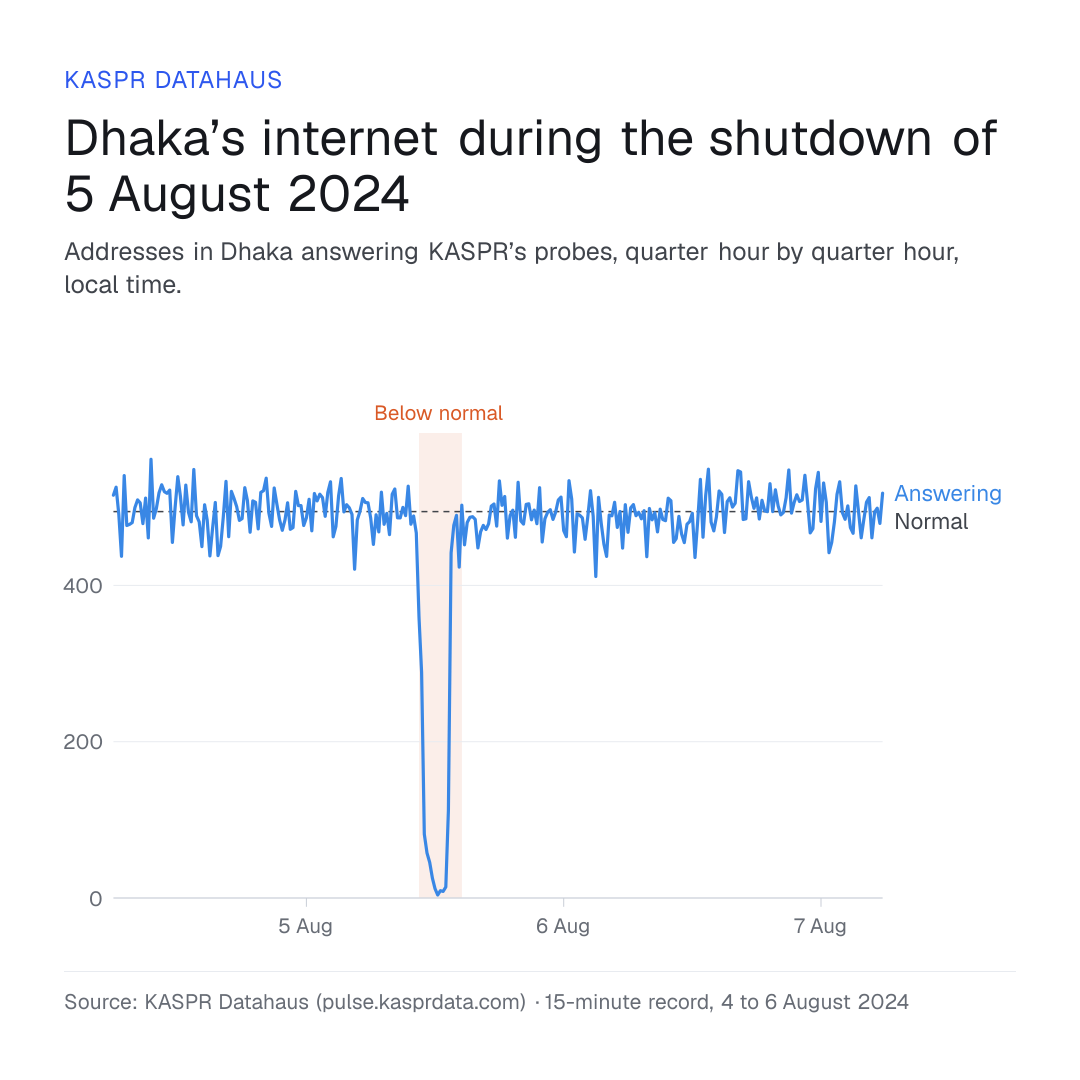
On the morning of 5 August 2024, as weeks of student-led protests reached the capital, Bangladesh’s internet was cut; by the afternoon the prime minister had resigned and access was back. In our record of Dhaka the number of addresses answering fell to 0.8% of normal within two hours and had recovered 4 hours after the first drop. This page sets out that record, quarter hour by quarter hour, and offers the rows for download.
494
addresses answering per quarter hour, normally
0.8%
of normal at the lowest point
2.5
hours below half of normal
4
hours from first drop to recovery
What happened
A switch, thrown in the morning
Bangladesh had already imposed a national shutdown lasting days in July 2024, during the quota-reform protests. On 5 August, with a march on Dhaka called for the morning, access was cut again across the country. That afternoon Sheikh Hasina resigned and left the country, and access returned within hours. Public reporting places the cut in the late morning and the restoration in the early afternoon, local time.
The measurement
From normal to near-nothing in six quarter hours
In the 24 hours before the cut, about 494 addresses in Dhaka answered our probes each quarter hour. At 10:30 local time the count fell below 90% of that; by 12:15 it was 4, 0.8% of normal. It stayed below half of normal for 2.5 hours and was back above 90% by 14:30. The fall and the return are both near-vertical: the signature of access being switched off and on, not of infrastructure failing and being repaired.
Times in the text are local (Asia/Dhaka); the chart axes are UTC.
Latency and vantage points
The few that answered, answered slowly
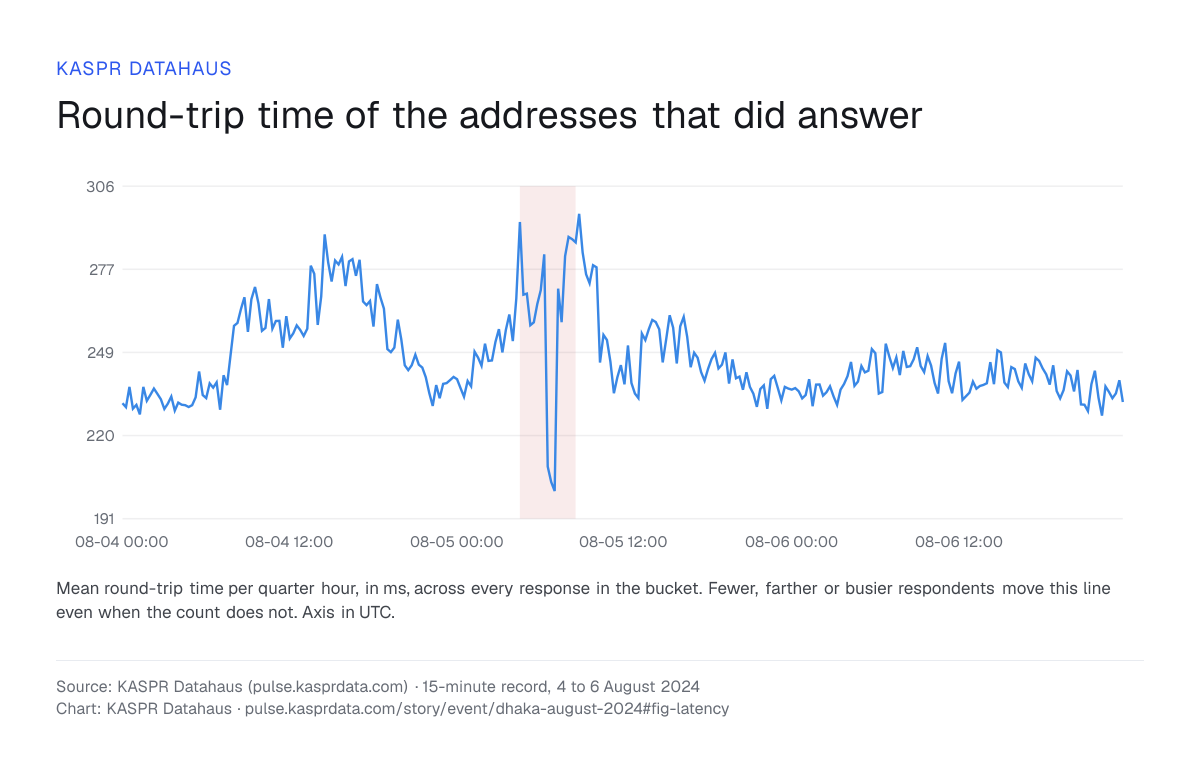
Round-trip time for the addresses that still answered rose from a median of 253 ms before the cut to 269 ms during it. At the deepest point only 3 of our 7 scanner paths recorded any response from the district: the handful of addresses still reachable were seen by few vantage points at once. When access returned, latency fell back with the count.
The shape
What a shutdown looks like in measurement
Two things distinguish this record from an outage. The fall is a step, not a slope: there is no draining of backup power or gradual loss of routes, just a count that goes to almost nothing between one quarter hour and the next. And the floor is not zero: a few addresses kept answering throughout, as they did through Iran’s June 2025 blackout, which points to infrastructure exempt from the restriction.
What the measurement adds is timing to the quarter hour, from outside the country, on a schedule that did not depend on anyone inside being able to report.
How to read it
Every quarter hour, scanners outside the country probe a fixed sample of addresses in the district. The count is how many answered, rebased so that months with different scanner coverage compare; it is a relative measure. Normal is the median of the 24 hours before the documented onset. The measurement records timing, depth and shape; the cause comes from the public record.
Independent, coarser corroboration: Cloudflare Radar outage centre
The same 15-minute measurement, replayed for another district: Open Live
Questions and answers
- What happened to the internet in Dhaka on 5 August 2024?
- Bangladesh’s internet was cut on the morning of 5 August 2024, as protests reached the capital. In KASPR’s record of Dhaka the addresses answering fell below 90% of normal at 10:30 local time and reached 4 at 12:15, 0.8% of the normal 494 per quarter hour. Access was back above 90% of normal by 14:30.
- How long did the Bangladesh internet shutdown of 5 August 2024 last in Dhaka?
- 4 hours from the first drop to recovery, with 2.5 hours below half of normal. The fall and the return were both near-vertical, the signature of access being switched off and on.
- Did internet latency in Dhaka change during the shutdown?
- Round-trip time for the addresses that still answered rose from a median of 253 ms before the cut to 269 ms during it. At the deepest point only 3 of KASPR’s 7 scanner paths recorded any response from the district.
- Can I download the Dhaka shutdown data?
- Yes. The three days around the event, 4 to 6 August 2024, are a free CSV download at 15-minute resolution: round-trip time and provenance for each quarter hour, the same rows this page describes.